


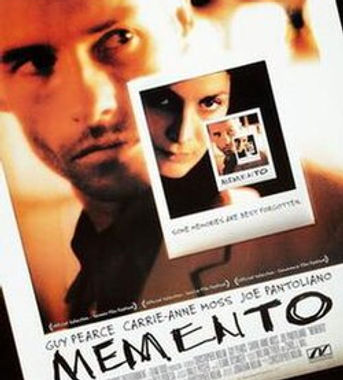
“I have to believe in a world outside my own mind.”
synopsis
Leonard Shelby suffers from short-term memory loss after a traumatic attack that killed his wife. Unable to form new memories, he relies on tattoos, Polaroids, and handwritten notes to track down the man he believes is responsible. The story unfolds in reverse chronological order, mirroring Leonard’s fractured perception of reality.

pairs well with ...
mini-review
This is noir turned inside out. Instead of a detective uncovering truth, we watch a man reconstruct (and possibly fabricate) his own narrative. The reverse structure isn’t a gimmick — it places the viewer in Leonard’s mental prison. The film’s moral center is deeply unsettling: what if justice is just a story we tell ourselves? Sharp, controlled, and devastating in its implications.
A man who cannot remember the past is convinced he understands it completely.
Absurdist's Corner
A man who cannot remember the past is convinced he understands it completely.
fun facts
Based on a short story by Christopher Nolan’s brother, Jonathan Nolan.
The film was shot in chronological order for the black-and-white segments and reverse for the color scenes.
It launched Nolan into major-director status.